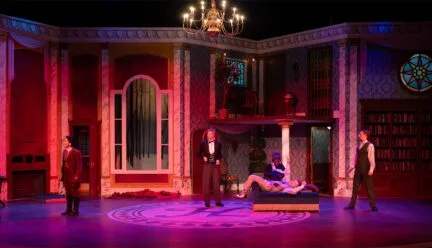
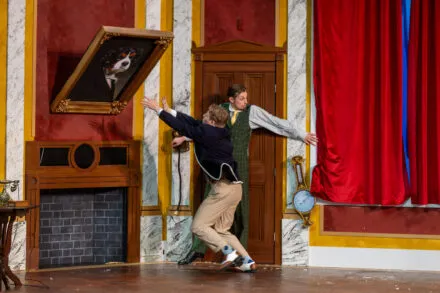
Production photo of set pieces beginning to break down. Photo by Darrell Hoemann.
Engineering Chaos: The Technical Brilliance Behind a Collapsing Set
By Aditi Khandelwal
Fallon Podrazik, raised in Wyoming, has always been drawn to the world of theatre. What began as a general fascination soon crystallized into a profound love for scenic design. This passion found guidance and form at the Sargent Conservatory of Theatre Arts at Webster University, where Podrazik immersed herself in the craft and began shaping her artistic voice. Now pursuing her master’s at the University of Illinois, she continues to refine that voice. Her work on The Play That Goes Wrong stands as evidence of a designer who can marry technical complexity with a razor-sharp sense of theatricality.
The Play That Goes Wrong, a play by Henry Lewis, Jonathan Sayer, and Henry Shields, and directed at Krannert Center by J.W. Morrissette and Aaron Muñoz, remains one of the most hilarious and masterful productions I’ve witnessed. Stepping into the theatre felt like stepping into another century. Podrazik’s scenic world evoked the sophistication of the 1800s: walls coated in deep red, wooden cabinets crowded with books, portraits in ornate gilt frames, pale blue windowpanes set against patterned wallpaper, stately pillars supporting a second-floor study, even a compact elevator tucked neatly into the corner, all crowned by a glittering chandelier. Inspired by Late Georgian and Early Regency manor houses, the set radiated refinement. It was the kind of beauty you’d fear damaging. And then, remarkably, delightfully, it all began to fall apart.
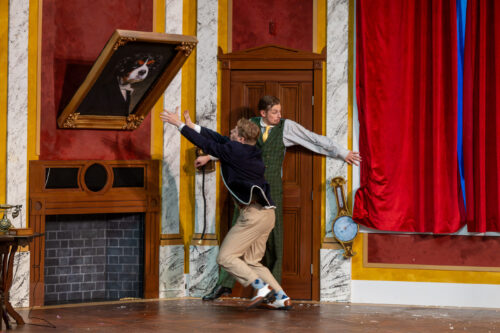
Production photo of set pieces beginning to break down. Photo by Darrell Hoemann.
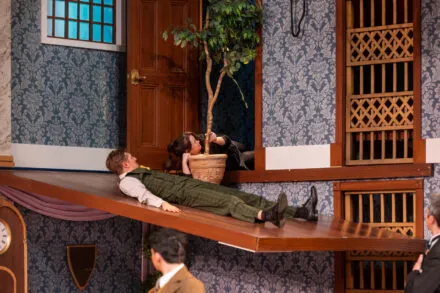
Photo by Darrell Hoemann.
middle
As the play-within-a-play murder mystery at the Haversham Manor unfolded, so too did the cleverly orchestrated collapse of the world around the actors. Lines were fumbled, cues missed, props misplaced; an intentional unraveling that became a characterin its own right. At first, the breakdown was subtle: a tilted painting, a stubborn door, a spinning bookshelf. But as the chaos intensified, the scenic design escalated in tandem. A pillar gave way. The elevated study platform slowly slanted until an actor slid helplessly down it. The elevator jammed. Walls toppled. And finally, in a perfectly timed climax, the chandelier plummeted toward the villain. Sitting in the audience, I never anticipated that a set crafted with such elegance would transform into a source of theatrical mayhem. Chaos so precise it required extraordinary care to pull off.
In conversation with Podrazik, she spoke candidly about the challenges of designing for two shows simultaneously: the fictional Murder at Haversham Manor and the meta-comedy The Play That Goes Wrong. The process was long and layered. It began with extensive research, poring over reference books at the library, absorbing the script, studying the era’s architecture and décor, and ensuring every detail served both the world of the play and the mechanics of the comedy. Collaboration was essential: she worked closely with costume designers, actors, and especially technical director, Matt Grenier, whose expertise helped translate her vision into a structurally sound and safely collapsible set.
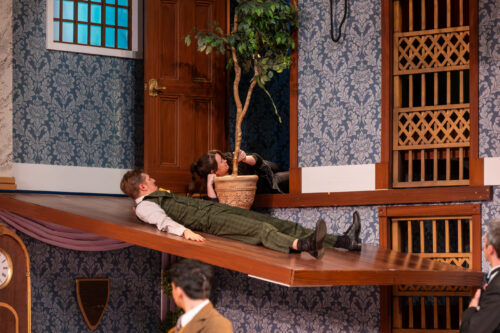
Photo by Darrell Hoemann.
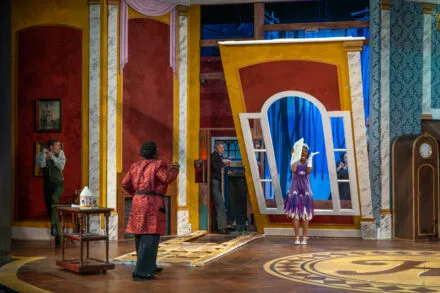
Photo by Darrell Hoemann.
conclusion
Every moving piece, every hinge, every wobble required precision. The team engineered a set that could fail spectacularly while still protecting the actors and maintaining the illusion of spontaneous disaster. For Podrazik, the most rewarding moment came after the design and construction stages: sitting in the audience and watching her creation breathe, creak, crack, and ultimately triumph as a storytelling force.
Podrazik’s work on The Play That Goes Wrong is a testament to the power of scenic design to do more than support a story. Her set did more than frame the chaos; it performed it. And in doing so, it reminded audiences that theatre is a living art form, one where even the walls can have a sense of humor.
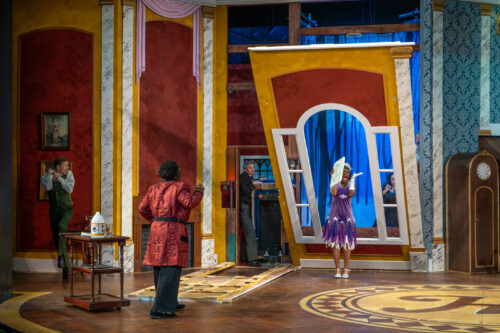
Photo by Darrell Hoemann.
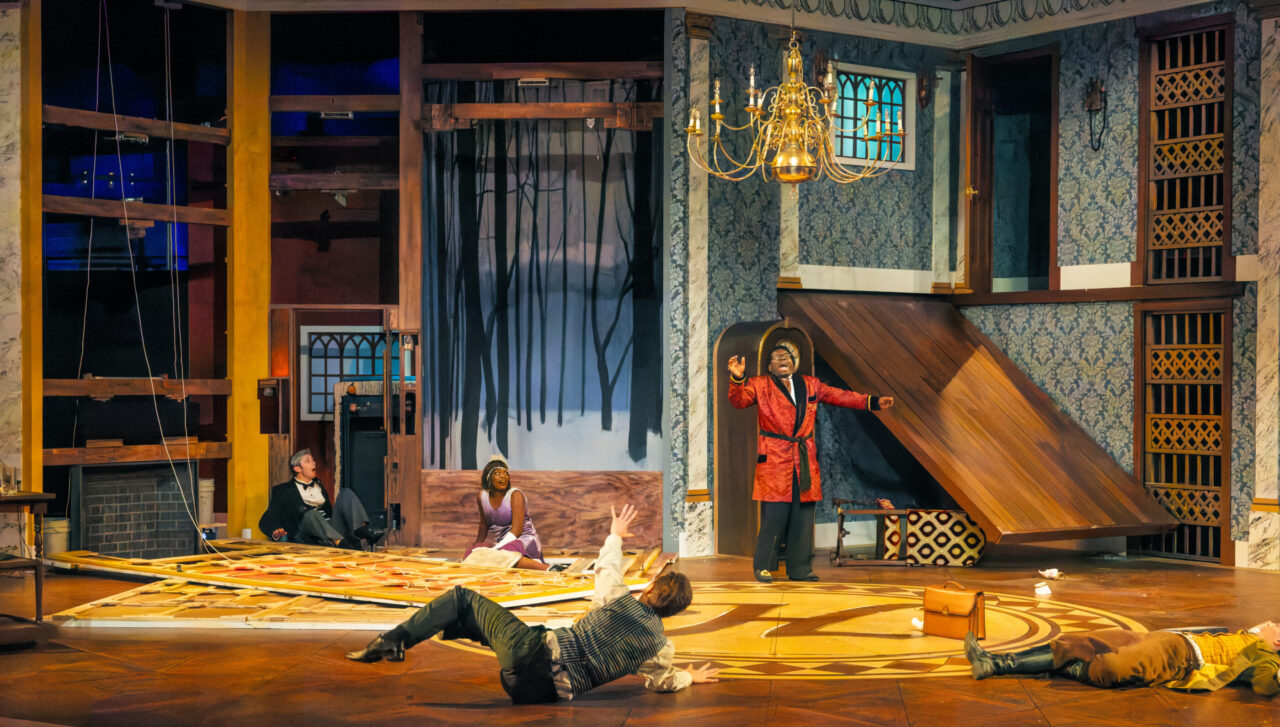
By the end of the performance, the set has completely “fallen apart” and the large chandelier that has loomed above the audience and stage all night plummets to the ground. Photo by Darrell Hoemann.