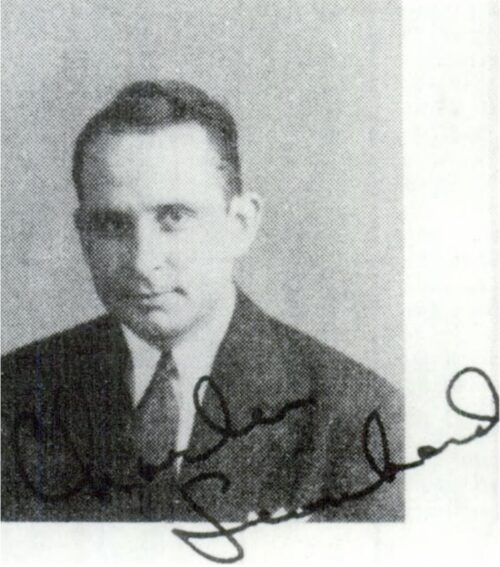
Charles Leonhard
Inducted in 2025
Charles Leonhard was a towering figure in American music education and a leading advocate for viewing music not merely as a skill or discipline but as aesthetic education—worthy of inclusion as a vital part of public schooling. Born in Anadarko, Oklahoma, he earned his Bachelor of Music in piano from the University of Oklahoma, followed by his MA and EdD at Teachers College, Columbia University. There he absorbed the influence of John Dewey and studied aesthetics with philosopher Susanne Langer.
Leonhard began his professional career teaching in Oklahoma public schools, later serving as a U.S. Army field artillery officer during World War II before joining Teachers College as an instructor and assistant professor. In 1951, he joined the University of Illinois Urbana‑Champaign’s faculty, where he directed the doctoral program in music education for 35 years, advising nearly 100 dissertations. Many of his students—including Bennett Reimer, Robert House, and Wayne Bowman – became influential scholars and practitioners, perpetuating his vision nationwide.
In 1953, Leonhard authored the groundbreaking article “Music Education; Aesthetic Education,” urging a shift from utilitarian instruction to nourishing the intrinsic beauty of music. In 1959, he coauthored Foundations and Principles of Music Education with Robert House, affirming its place as a cornerstone text in the field. He was a key founder of the Bulletin of the Council for Research in Music Education with Richard Colwell in 1963.
Retiring in 1986, Leonhard continued as director of research at the National Arts Education Research Center until 1994. His lifelong advocacy cemented music education’s aesthetic mission—a legacy upheld today by the National Association for Music Education. In 1994, he was inducted into the MENC Hall of Fame alongside other historic leaders. His influence remains vibrant in academia and beyond, thanks in no small part to the many students he mentored and inspired.