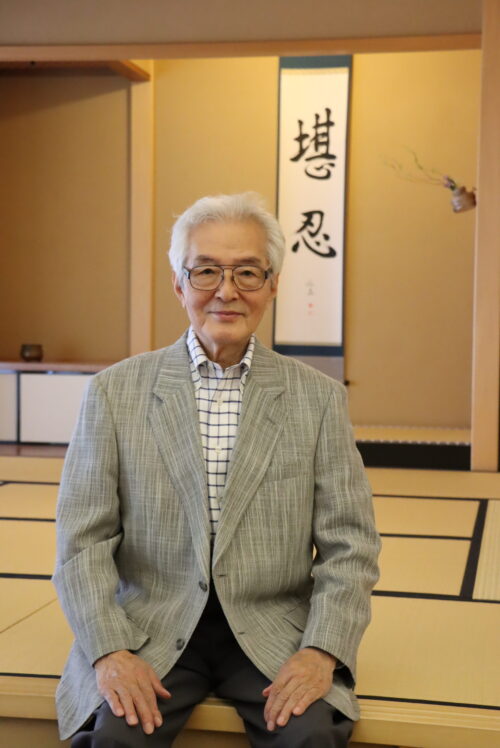
Shozo Sato
Inducted in 2025
Shozo Sato was born in Kobe, Japan, on May 18, 1933, and grew up in Kamakura during the turbulent years of World War II. The destruction and disillusionment of the postwar period left a deep impression on him and planted the seeds for a lifelong commitment to using art as a means of healing, understanding, and cross-cultural dialogue.
Trained in traditional Japanese arts—including ikebana (flower arranging), shodō (calligraphy), sumi-e (ink painting), and chadō (tea ceremony)—Sato was also a disciple of the renowned kabuki master Nakamura Kanzaburō XVII. In a rare and distinguished honor, he was adopted into the Nakamura kabuki family in 1985. With both classical mastery and an innovative spirit, Sato became known for adapting Western dramatic works, such as Kabuki Macbeth, Kabuki Medea, and Achilles: A Kabuki Play, into the stylistic language of kabuki, earning international acclaim for his bold and respectful fusion of East and West.
In 1964, he was invited by Professor Margaret Erlanger to the University of Illinois as a visiting artist, and in 1969 he became artist-in-residence at the newly opened Krannert Center for the Performing Arts. In 1975, Sato transformed an old Victorian house into the first iteration of Japan House, a space for immersive learning in traditional Japanese arts. His teaching blended technique with philosophy, aesthetics with moral principles—always grounded in the ideals of humility, presence, and harmony.
Professor Emeritus Sato inspired generations of students through his courses in kabuki, tea ceremony, calligraphy, and sumi-e, as well as through his many publications, including The Art of Sumi-e, The Art of Flower Arranging, and Shodo: The Quiet Art of Japanese Zen Calligraphy. He was beloved for his generosity and unwavering commitment to beauty as a path toward empathy.
Even after his formal retirement from the university in 1992, Sato continued to teach, travel, and perform around the world, establishing another teaching center in Fort Bragg, California, to continue his lifelong pursuit of sharing Japanese aesthetic practices. In his later years, he and his wife, Alice Ogura Sato, retired once again to Champaign, Illinois, where he remained deeply engaged with the community and the University of Illinois, continuing to share his knowledge and passion for Japanese arts.
In a fitting tribute to his artistic journey, his final exhibition The Ink Wash Paintings of Shozo Sato was held at Krannert Art Museum in 2023. The show offered a profound reflection on his evolving artistry and served as a final gesture of gratitude and presence.
His impact remains indelibly etched into the lives of his students and the physical and spiritual foundation of Japan House. Shozo Sato’s legacy is not only in the artworks he created or the performances he directed but in the values he instilled—respect, mindfulness, and the belief that art can bridge even the widest divides.